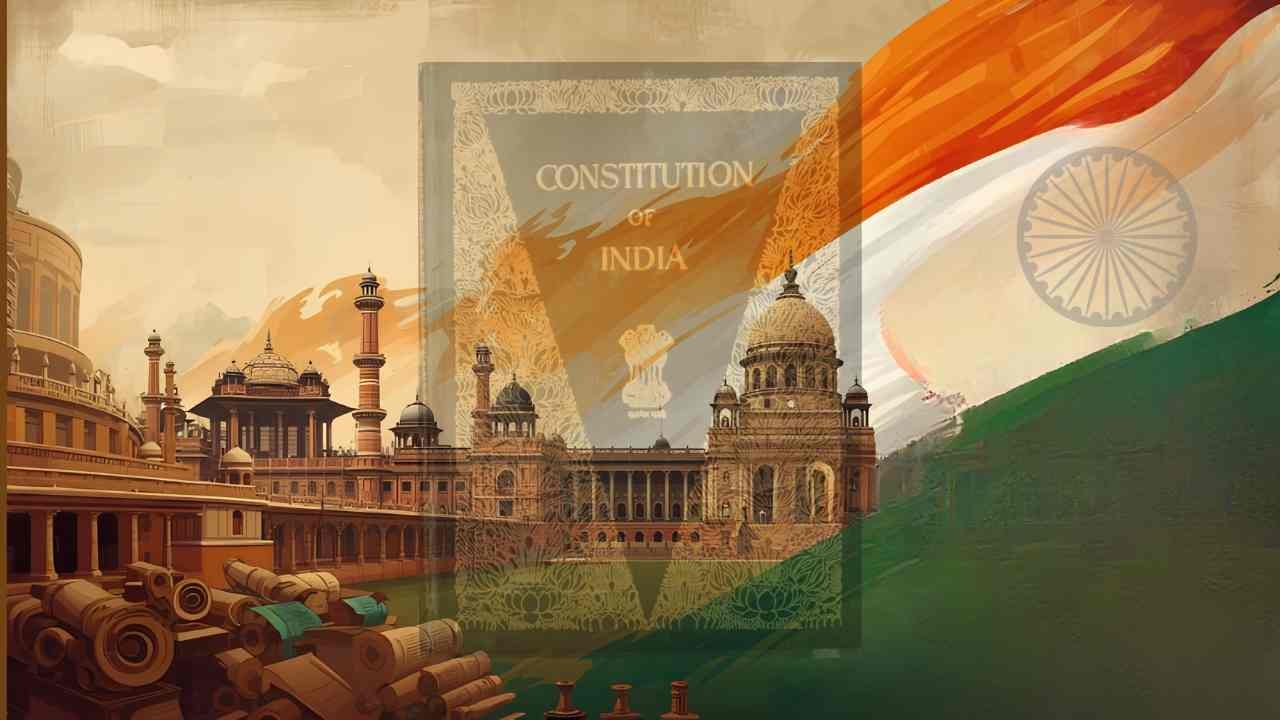
The Indian Constitution was not a document formed in a single day. Centuries of events, wars, treaties, and political ideas together laid the foundation for this remarkable document, which came into force on January 26, 1950.
Click here to Read the Telugu version of this article.
In 1600, British Queen Elizabeth-I granted a charter that allowed the East India Company to begin trade in India. In 1608, William Hawkins obtained permission from Mughal Emperor Jahangir to conduct trade in Surat, and in 1615, Thomas Roe secured authority for overall trade in India.
The Battle of Plassey in 1757 marked the beginning of the British Empire in India, while the Battle of Buxar in 1764 laid strong foundations for its expansion. In 1765, the Treaty of Allahabad and Robert Clive’s introduction of dual government in Bengal further strengthened the Company’s authority.
From 1773 onwards, the East India Company gradually established administrative systems and laws. After the Sepoy Mutiny of 1857, Company rule ended in 1858, and India came directly under the control of the British Crown (the British Government). However, governance continued without a constitution. The laws and administrative reforms introduced during this period greatly influenced the framing of the Indian Constitution.

Constitutional historian B.C. Rawat divided this evolution into six stages:
1600-1773 (Company Establishment), 1773-1858 (Regulated Rule), 1858-1909 (Crown Rule), 1909-1935 (Political Reforms), 1935-1947 (Self-Governance), 1947-1950 (Constitution-Making)
Changes in each stage finally led to the formation of the Constituent Assembly in 1946, and after prolonged discussions, the Constitution of India came into force on January 26, 1950. Today, the Indian Constitution stands as the supreme law of the land and the foundation of democracy.
From coming for trade, to ruling the nation, and ultimately leading to the birth of a sovereign republic – this evolution remains truly extraordinary.

📢 Which phase fascinates you the most?
💬 Share your thoughts below