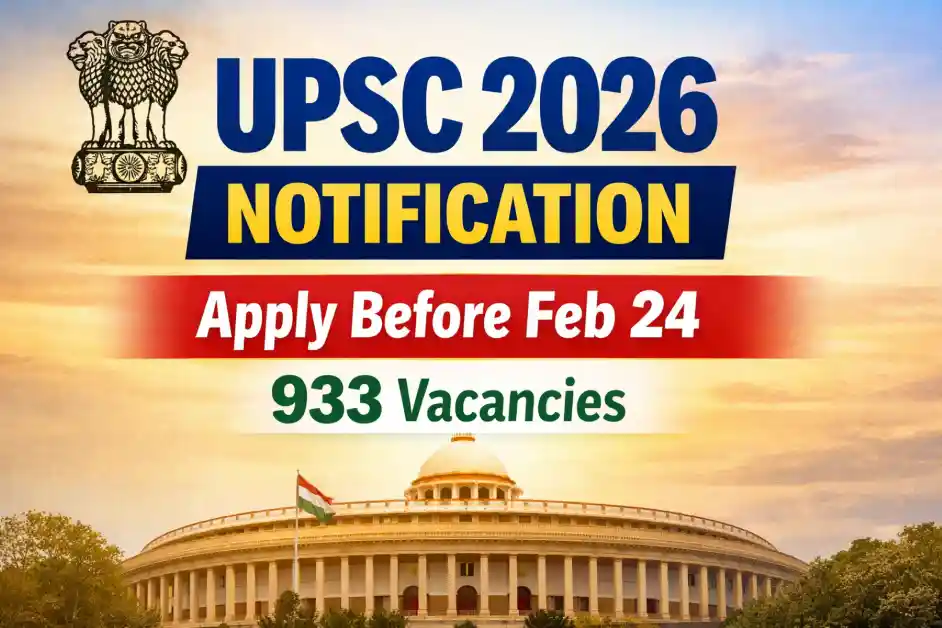
The Union Public Service Commission (UPSC) has released the Civil Services Examination (CSE) 2026 notification and online applications have started. Graduates aspiring for services like IAS, IPS and IFS should check the last date, eligibility and exam pattern before applying.
The Civil Services Examination is the recruitment process for India’s top administrative services and serves as the gateway to careers such as District Collector, Superintendent of Police and Indian Diplomat. It remains one of the most sought-after competitive examinations in the country.
Table of Contents
📌 UPSC CSE 2026 Notification – Important Dates
| Particular | Details |
| Notification Date | 4 February 2026 |
| Last Date to Apply | 24 February 2026 (6:00 PM) |
| Prelims Exam Date | 24 May 2026 |
| Vacancies | Around 933 |
| Application Mode | Online Only |
Why This Notification Matters
The UPSC Civil Services Examination is conducted only once every year. Missing the last date means waiting for the next year. Since the preliminary exam is only a few months after the notification, candidates who plan to write seriously should begin revision immediately rather than starting preparation from zero.
🏛 Posts You Can Get Through UPSC (IAS, IPS, IFS & More)
Through a single examination, UPSC recruits officers into multiple central government services. Many aspirants think UPSC means only IAS, but actually it opens doors to several high-level careers.
Major services include:
- Indian Administrative Service (IAS)
- Indian Police Service (IPS)
- Indian Foreign Service (IFS)
- Indian Revenue Service (IRS)
- Indian Postal Service
- Indian Audit & Accounts Service
- Railway and other Group-A central services
In simple terms, officers selected through this exam are responsible for administration, policy implementation, taxation, foreign relations and public welfare programs.
👤 UPSC Eligibility, Age Limit & Qualification
Before applying, candidates must ensure they satisfy the eligibility conditions.
Educational Qualification
A candidate must possess a Bachelor’s Degree in any discipline from a recognized university. Final year students can also apply, but they must complete graduation before the interview stage.

Age Limit
- Minimum Age: 21 years
- Maximum Age: 32 years (as on 1st August 2026)
Age Relaxation
- OBC: +3 years
- SC/ST: +5 years
- Persons with Benchmark Disability(PwBD): up to +10 years
Nationality
For IAS, IPS and IFS — candidate must be an Indian citizen.
Who Should Think Before Applying
UPSC preparation requires long-term consistency. Candidates should apply only if they are ready to read daily, follow current affairs and study regularly for many months.
🔢 Number of Attempts Allowed
| Category | Attempts |
| General | 6 |
| OBC | 9 |
| SC/ST | Unlimited (within age limit) |
Even appearing in one paper of the Preliminary Examination counts as an attempt.
🧠UPSC Selection Process (3 Stages)
The Civil Services Examination is conducted in three stages:
- Preliminary Examination
- Main Examination
- Interview / Personality Test
Only candidates who qualify each stage are promoted to the next stage. Final selection is based on marks obtained in the Mains examination and the Interview.
📘 UPSC Prelims Exam Pattern 2026 (GS & CSAT Explained)
The Preliminary Exam is a screening test used to shortlist candidates for the Main Examination. Marks obtained here are not counted in final ranking.
| Paper | Subject | Type | Marks | Duration |
| Paper I | General Studies (GS) | Objective (MCQ) | 200 | 2 Hours |
| Paper II | CSAT (Aptitude) | Objective (MCQ) | 200 | 2 Hours |
Prelims Exam Important Rules
- CSAT paper is qualifying (minimum 33% required)
- Only GS Paper-I marks decide cutoff
- Negative marking applies: 1/3 mark deducted for each wrong answer
- No penalty for unanswered questions
🧾 UPSC CSE 2026 Mains Exam Pattern & Marks Distribution
Candidates who clear prelims appear for the descriptive (written) Mains examination.
| Paper | Subject | Marks | Nature |
| Paper-A | Any Indian Language (Compulsory) | 300 | Qualifying |
| Paper-B | English | 300 | Qualifying |
| Paper-I | Essay | 250 | Merit |
| Paper-II | General Studies-I | 250 | Merit |
| Paper-III | General Studies-II | 250 | Merit |
| Paper-IV | General Studies-III | 250 | Merit |
| Paper-V | General Studies-IV (Ethics) | 250 | Merit |
| Paper-VI | Optional Subject – Paper 1 | 250 | Merit |
| Paper-VII | Optional Subject – Paper 2 | 250 | Merit |
Total Mains(Written) Exam Marks: 1750
Key Structure of Mains Exam
- Total papers: 9
- Qualifying papers: 2
- Merit papers: 7
Why Mains Is Important
The mains examination tests answer-writing ability, clarity of thinking and balanced opinion. Regular writing practice becomes essential at this stage.
🎤 Interview / Personality Test
| Stage | Marks |
| Personality Test (Interview) | 275 |
Final merit list is prepared based on Mains (1750) + Interview (275) = 2025 marks.
Important Points About UPSC CSE 2026 Examination
- The marks obtained in the Preliminary Examination are only for screening purposes and are not counted in the final merit list.
- Final ranking and service allocation are based on the combined scores of the Main Examination and the Personality Test (Interview).
- There is a penalty for wrong answers in the Preliminary stage, so guessing answers without elimination can reduce the overall score.
- Candidates must secure qualifying marks in both compulsory language papers in the Mains; otherwise, their other papers will not be evaluated.
💰 Application Fee
- ₹100 for General candidates
- Women, SC, ST and PwBD candidates: No fee
📍 Examination Centres
The Preliminary Examination is conducted across India including major centres such as Hyderabad, Vijayawada, Visakhapatnam and Tirupati. Centres are allotted on a first-apply basis, so applying early is advisable.
📝 How to Apply for UPSC CSE 2026
- Visit the UPSC online application portal
- Complete One-Time Registration (URN)
- Fill the Civil Services Examination form
- Upload photo and signature
- Pay fee (if applicable)
- Submit before the last date i.e. 24 February 2026 (6:00 PM)
🔗 Apply Links
- Official UPSC Website
- Apply Online – UPSC Application Portal
- Download Official Notification PDF
Candidates are advised to read the official notification carefully before submitting the application form.
⚠️ Important Rules Candidates Must Know
- Mobile phones and smart watches are strictly banned inside exam halls
- Identity verification may be conducted at the exam centre
- Late entry is not allowed
- Application once submitted cannot be edited or withdrawn
🎯 Who Should Apply for UPSC?
You can consider UPSC seriously if you want:
- A respected government career
- Long-term job security
- Administrative authority
- Opportunity to serve society
📚 Syllabus Overview (Very Brief)
The Civil Services Examination does not focus on a single subject. It evaluates a candidate’s general awareness and understanding of society, governance and current issues.
Broad areas covered in the UPSC syllabus include:
- Current events of national and international importance
- History of India and the Indian National Movement
- Indian Polity and Governance (Constitution, political system, public administration and public policy)
- Geography of India and the World
- Economic and Social Development (economy, poverty, development and budgeting)
- Environment, ecology and climate-related issues
- General science and technology developments
- Ethics, integrity and aptitude (evaluated in the Mains stage)
🧭 How to Start UPSC Preparation (Beginner Plan)
Month 1 – Build Basic Understanding
- Read NCERT History (ancient and medieval basics)
- Read NCERT Geography (physical and Indian geography)
- Start daily newspaper reading (30–40 minutes)
- Begin basic CSAT practice (comprehension and reasoning)
Month 2 – Core Subjects
- Indian Polity (Constitution, fundamental rights, Parliament)
- Modern Indian History (freedom movement)
- Continue newspaper reading and make short notes
Month 3 – Expand to Economy & Answer Writing
- Learn basic economy concepts (inflation, budget, banking and government schemes)
- Start writing short answers (5–6 lines) from current affairs topics
- Practice previous year prelims questions
Start with 2–4 hours of study daily and gradually increase. Consistency matters more than studying for very long hours occasionally.
❓ Frequently Asked Questions (FAQs)
1. Can 12th pass apply?
No. Graduation is compulsory.
2. Can final year students apply?
Yes. But degree must be completed before interview.
3. Which degree is best for IAS?
Any degree. UPSC does not prefer any specific stream.
4. Can B.Tech students clear UPSC?
Yes, a large number of selected candidates are engineers.
5. Is coaching necessary?
No, self-study is sufficient with proper guidance. Many toppers clear UPSC with self-study.
6. Can an Average Student Clear UPSC?
Yes. UPSC does not test intelligence alone. It tests consistency, understanding and answer writing.
7. Can working professionals prepare?
Yes, many candidates prepare alongside jobs.
8. How many hours should I study daily?
Beginners: 3–4 hours
Serious preparation: 6–8 hours.
9. Is UPSC the toughest exam?
It is competitive because of the vast syllabus and lakhs of applicants.

📢 For daily updates on upcoming vacancies, visit our Latest Government Job Notifications page where all new recruitments are updated regularly.
✨ Final Advice for UPSC Aspirants
The UPSC Civil Services Examination is not just a job notification but a career opportunity to become a policymaker and administrator. Consistent preparation and patience are the real keys to success.
If you start preparation today, you already take the first step toward one of India’s most respected careers.
Every topper once started with:
- NCERT books
- Newspaper reading
- Basic answer writing
Start today. Even 2–3 hours daily is enough in the beginning.
Because UPSC is not cleared by intelligence alone, it is cleared by consistency.
All the Best.